
On May 19, 2026, Andrej Karpathy posted four sentences on X that got 148,000 likes. He'd joined Anthropic. Not OpenAI, not Google, not some new startup. Anthropic.
I've been thinking about this for weeks now, and I keep coming back to one detail that most coverage missed: his actual job description.
What Karpathy is actually doing
He's not just joining the pre-training team. He's building a new team within it, reporting to Nick Joseph, who runs Claude's technical development.
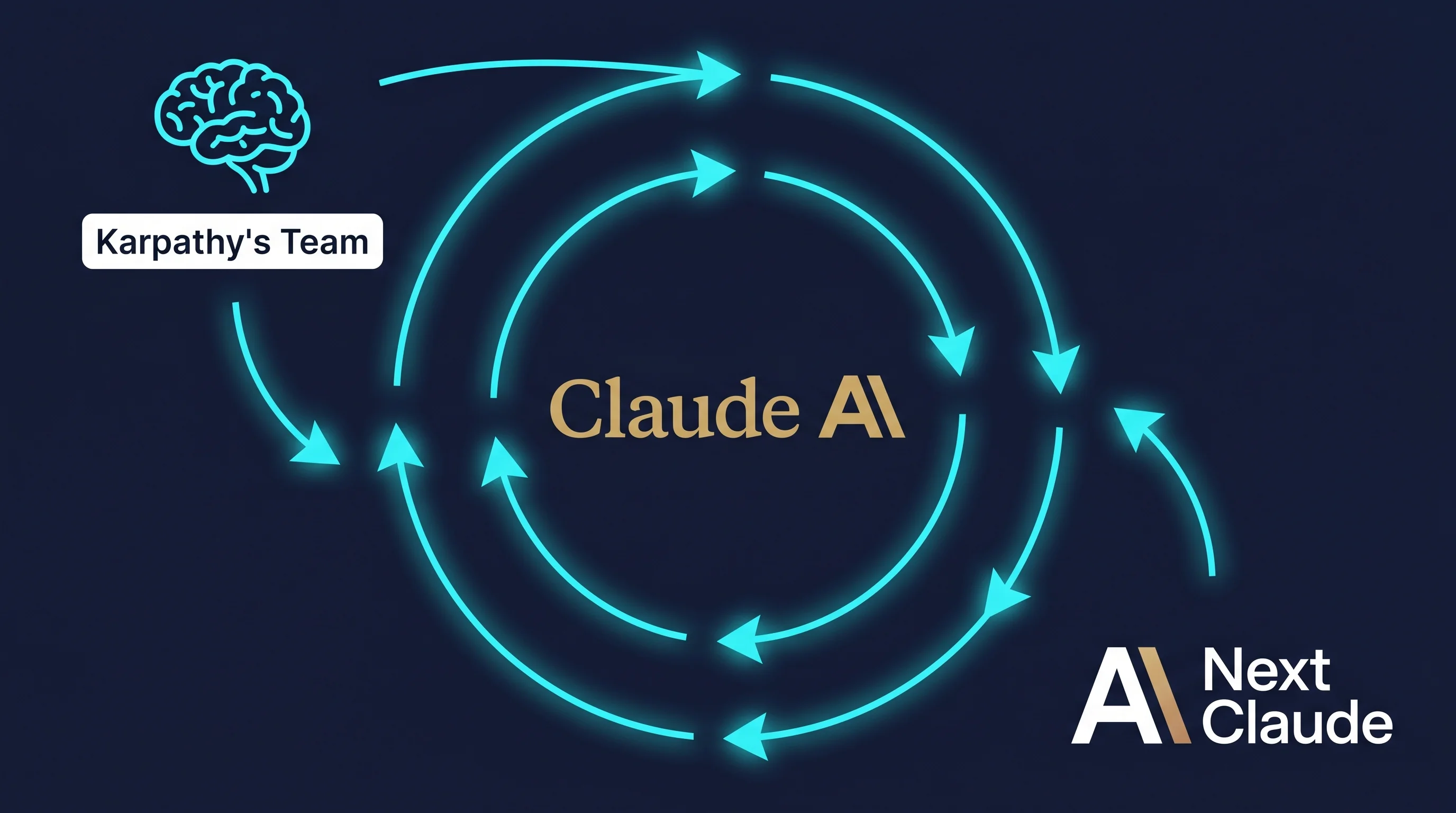
Here's the part that stopped me: his team's job is to use Claude to accelerate pre-training research.
Let that sink in. They're using the model to build a better version of the model. It's recursive. It's self-referential. And it might be the most interesting bet in AI right now.
Why this matters more than it looks
Pre-training is the expensive part. When I say expensive, I mean the kind of expensive where you burn through millions of dollars in compute on a single training run that takes weeks. It's the phase where the model learns everything it knows.
Most labs are still throwing raw compute at this problem. Bigger clusters, longer runs, more GPUs.
Anthropic's betting on something different. They're betting that research velocity matters more than raw scale. That if you can make the research process itself faster, smarter, more efficient, you win the race without needing the biggest data center.
And they hired the guy who literally wrote the book on teaching neural networks from scratch to lead that effort.
Karpathy's track record is weird
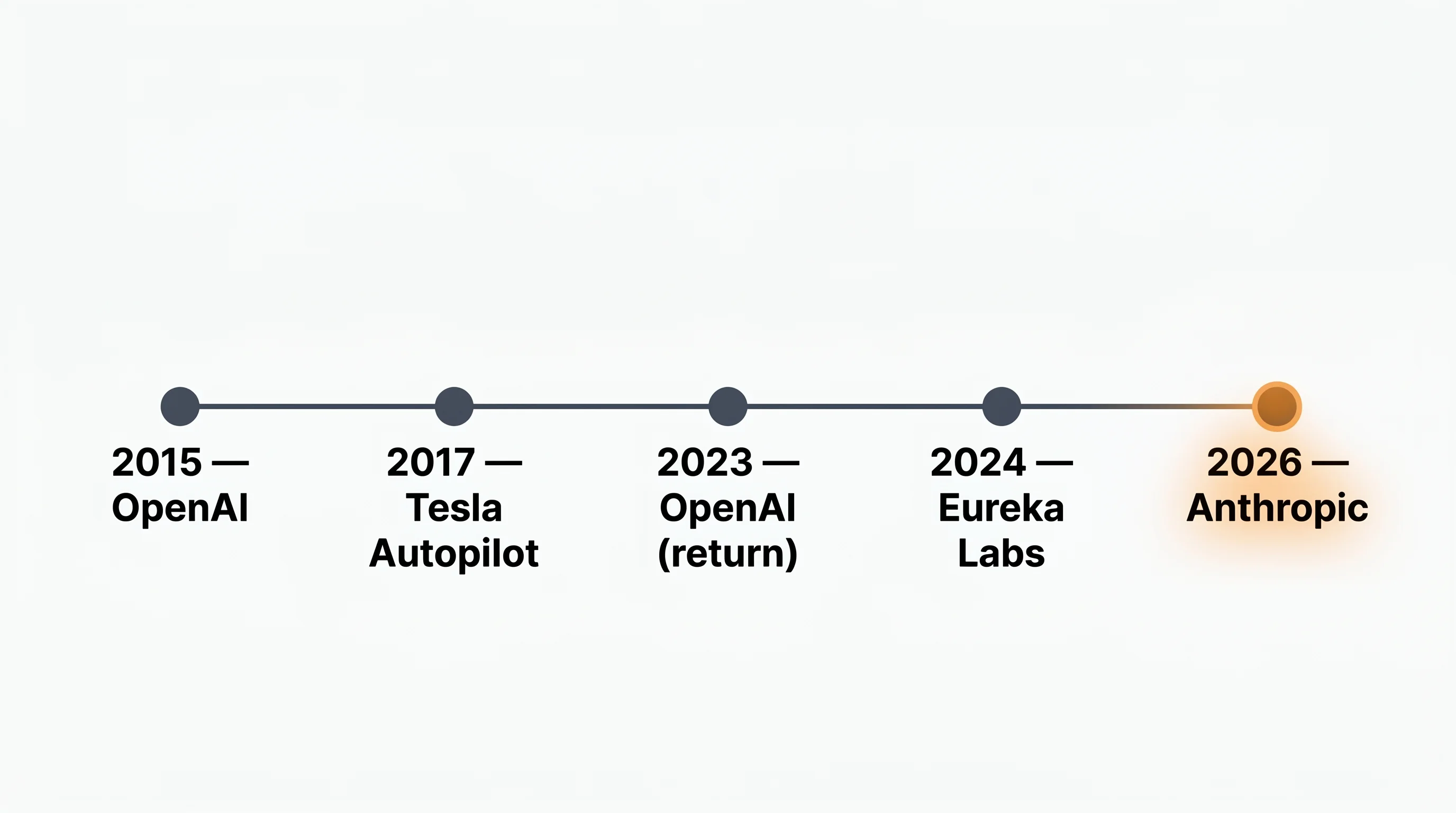
Let's look at the actual timeline:
- 2015: Co-founds OpenAI
- 2017: Leaves OpenAI to join Tesla
- 2017-2022: Runs Tesla's Full Self-Driving and Autopilot programs
- 2023: Goes back to OpenAI for one year
- 2024: Leaves again to start Eureka Labs (AI education startup)
- 2026: Joins Anthropic
That's not a normal career path. That's someone who keeps finding the most interesting problem in AI and moving toward it.
His Neural Networks: Zero to Hero YouTube series has millions of views. His micrograd tutorial (where he builds a neural network library from scratch in about 100 lines of code) is basically required viewing for anyone learning ML.
This is the guy who explains backpropagation by literally building it from scratch, step by step, until you understand every single gradient flowing through the network.
Now he's going to use that same first-principles thinking to make Claude build better versions of itself.
The actual announcement
Here's what he posted on X:
Notice what he didn't say. He didn't say "excited to scale AI" or "thrilled to push boundaries." He said "get back to R&D."
That's the language of someone who wants to build things, not manage them.
What this means if you use Claude
Nothing changes today. Claude is still Claude.
But if you're making platform decisions for the next 12 to 18 months, this is a signal worth paying attention to.
When someone like Karpathy picks a lab, it usually means he's seen something in their technical approach that convinced him they're doing the most interesting work. Researchers at his level don't join companies without strong conviction about the underlying strategy.
The fact that Anthropic specifically asked him to build a team around AI-assisted research (not just scale up compute) tells you where they think the next breakthroughs come from.
The recursive play 🔄
Here's what I find genuinely interesting about this whole thing.
Most AI development right now is linear. You train a model, you deploy it, you collect data, you train the next model.
What Karpathy's team is doing is different. They're using Claude's reasoning capabilities to help design better training runs, better data pipelines, better architectures for the next Claude.
It's like having a really smart intern who can help you build a smarter version of themselves. And then that smarter version helps build an even smarter one.
This is the kind of feedback loop that could compound fast. Or it could hit diminishing returns immediately. We don't know yet.
What about Eureka Labs?
Good question. Karpathy said he's "deeply passionate about education" and plans to "resume work on it in time."
That's the kind of phrasing that usually means "not anytime soon."
Eureka Labs launched in 2024 with the goal of applying AI assistants to education. There hasn't been much public update since. It's unclear whether the startup continues, gets acquired, or quietly winds down.
Either way, Karpathy's clearly decided that the most interesting problem in AI right now isn't education. It's making AI that can help build better AI.
The talent war is real
Anthropic didn't just hire a good engineer. They hired someone with 15,000+ GitHub stars on micrograd, millions of YouTube views, and a reputation for explaining complex things clearly.
They also hired him at the exact moment when pre-training costs are becoming a real constraint for the industry. Everyone's hitting the limits of what you can do with pure compute scaling.
Bringing in someone who can bridge deep learning theory and large-scale production systems (he built Tesla's Autopilot, remember) is a strategic move.
What I'm watching for
Here's what I think matters in the next six months:
- Does Karpathy's team publish any papers or technical reports on AI-assisted research?
- Do we see measurable improvements in Claude's training efficiency?
- Do other labs start copying this approach?
If the answer to all three is yes, this hiring move will look like one of the most important strategic decisions in AI in 2026.
If not, it's still a fascinating experiment in recursive AI development.
Either way, I'm paying attention. And if you're building on Claude, you should be too.