


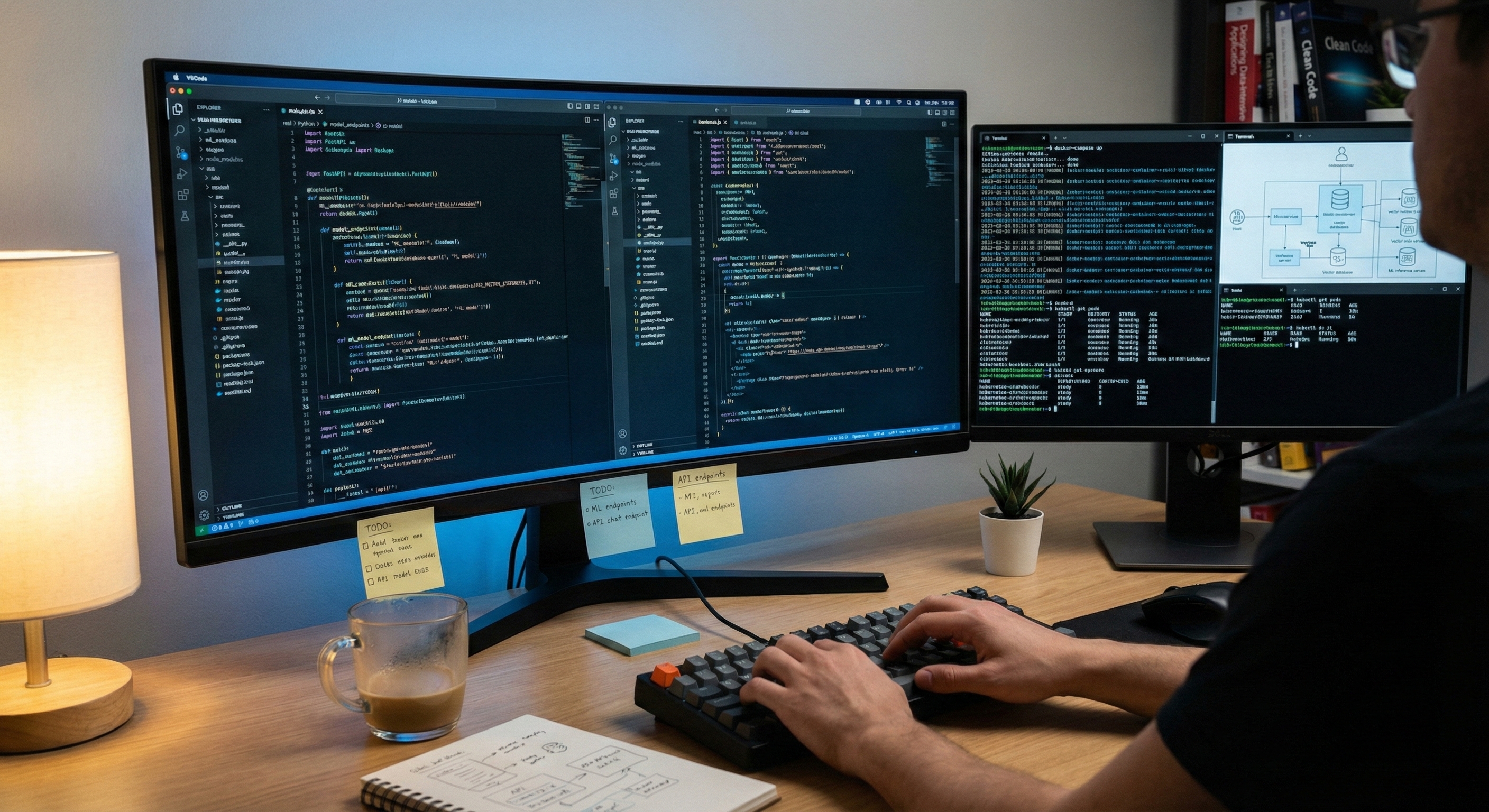
Beyond Models: Complete Production Systems
A machine learning model is maybe 5% of a production ML system. The real challenge—and where most AI projects fail—is everything else: robust data pipelines, API design and serving, frontend integration, deployment infrastructure, monitoring and alerting, and ongoing maintenance.
I build complete applications where AI isn't a feature bolted on at the end—it's woven into the architecture from the ground up. This means FastAPI backends optimized for ML workloads, React/Next.js frontends designed for AI UX patterns, Docker containerization for reproducible deployments, CI/CD pipelines for continuous delivery, and comprehensive monitoring and logging.
The Modern AI Stack
Backend: FastAPI for AI Serving - FastAPI has become the de facto standard for AI API development. Built on ASGI, it handles thousands of concurrent requests efficiently. Automatic data validation with Pydantic, interactive API documentation (Swagger UI), native async support for long-running inference, and seamless integration with Python's ML ecosystem make it ideal for AI workloads.
Frontend: Modern JavaScript Frameworks - I typically use React or Next.js for AI-powered frontends. The key is implementing AI-specific UX patterns: streaming responses for real-time feedback, appropriate loading states for model inference, error handling that maintains user trust, and state management for conversational interfaces.
Deployment: Cloud-Native Architecture - Production AI systems run on AWS, GCP, or Azure using Docker for containerization and portability, Kubernetes when orchestration is needed (but only when necessary), infrastructure as code (Terraform, Pulumi), and auto-scaling based on demand. The goal: systems that handle traffic spikes gracefully without ballooning costs.
MLOps: Making ML Operational
MLOps integrates software engineering, DevOps, and data science to manage the complete ML lifecycle. Production ML systems require several fundamental practices:
Version Control Everything - Code versioning (Git), data versioning (DVC, LakeFS), and model versioning (MLflow, Weights & Biases). Reproducibility isn't optional—if you can't reproduce a result, you can't trust it.
Automated CI/CD Pipelines - Automated testing (unit, integration, model performance), automated deployment (staging → production), rollback capabilities for failed deployments, and canary deployments for gradual rollout. Manual deployments don't scale and introduce human error.
Continuous Monitoring - Model performance metrics (accuracy, latency, throughput), data drift detection (is incoming data shifting?), concept drift detection (are relationships changing?), infrastructure monitoring (CPU, memory, GPU utilization), and cost tracking (ML inference is expensive at scale). What isn't measured can't be improved.
Automated Retraining Workflows - Models degrade over time as data evolves. Production systems need scheduled retraining on fresh data, automated model evaluation, A/B testing for model deployments, and automated promotion of better models to production.
Production Deployment Challenges
Research shows that deployment is where AI projects go to die. Key challenges include:
Serving Infrastructure - Real-time vs. batch predictions (different architecture implications), scaling inference to thousands of requests per second, GPU resource management and allocation, and load balancing across model replicas. These are not trivial problems.
Model Optimization - ML inference can be expensive and slow. I implement model quantization to reduce size and latency, knowledge distillation to compress models, caching strategies for repeated queries, and hybrid architectures that balance cost vs. performance.
Security and Compliance - AI systems introduce new attack vectors: input validation to prevent adversarial attacks, API security and rate limiting, data privacy and encryption, and compliance with regulations (GDPR, CCPA, industry-specific requirements).
The Production Reality
The difference between a working demo and a production system is everything invisible to users: error handling that fails gracefully, logging for debugging at scale, metrics for business stakeholders, testing that catches regressions, documentation for team members, and code quality that enables maintenance.
I've seen brilliant models fail in production because of poor engineering. I've also seen average models succeed because of excellent systems design. The engineering matters as much as the AI.
When I deliver a full-stack AI application, you receive a complete system ready for users—not a prototype requiring a rebuild. The code is tested, documented, and maintainable. The infrastructure scales. The monitoring surfaces issues before users notice them. That's the difference between a demo and a product.